


ATHENS, Ga. (The Oklahoma Post) March 27, 2025
In a time when transparency should guide policy and protect lives, Gregory and Jodi Moyer are speaking out. Their story is one of heartbreak, outrage, and relentless advocacy against a system that, they argue, enabled the death of Ashley Edmunds Shutza, Benji Smith, destruction of Peyton Moyer’s future. Two minor siblings were in the homes at the time of the murders. Their journey forever changed. This Sunshine Week, The Oklahoma Post shares their powerful appeal to the U.S. Department of Health and Human Services (HHS) and the Food and Drug Administration (FDA) to remove Invega Sustenna—and its iterations—from the market.
A Tragic Story Behind the Headlines
Peyton Moyer, a mentally ill man from Watkinsville, Georgia, was sentenced to life in prison at age 19. He was charged in a high-profile double homicide case involving the deaths of his mother, Ashley Shutza, and boyfriend Benjamin Smith. Mainstream media sensationalized the case, presenting it as a cut-and-dry murder without regard for mental health, medication side effects, or the role of systemic failure. Articles by outlets such as People Magazine, Fox 5 Atlanta, and Oxygen provided the public only one side of the story—a side devoid of crucial context.
What the public doesn’t know is this: Peyton was under the influence of paliperidone palmitate, a powerful antipsychotic drug known as INVEGA SUSTENNA®. It was administered to him as a teenager—against the will of his father, Gregory Moyer, and without informed consent. No comprehensive evaluation was performed, and tragically, the medical records were never made available to the court until the final day of trial.
Peyton’s mental incompetence was never properly addressed by the court or the prosecution. The timelines involving the examination of Peyton’s medical records and the subsequent plea agreement simply do not add up. Critical medical evidence relating to his diagnosed paranoid schizophrenia and intoxication was withheld from the court until the final day of proceedings, effectively depriving Peyton of the informed defense he deserved. This raises a profoundly troubling question: How can a young man with documented severe mental illness—unable to advocate for himself and clearly incapable of rational decision-making—be held fully accountable to the extent of receiving a life sentence without the possibility of parole? The discrepancies and failures in this case demand immediate scrutiny and reconsideration. Despite his documented diagnosis of paranoid schizophrenia, exacerbated by heavy intoxication and the use of illegal drugs known to induce paranoia and violent tendencies—the legal process largely ignored these critical factors. Troublingly, during Peyton’s incarceration in the Oconee County Jail, Sheriff James Hale permitted visitation by Ray McElroy, a known drug dealer previously documented in local media reports, as well as by Destiny McElroy. Meanwhile, Peyton’s biological father and stepmother—an experienced criminal defense attorney—were systematically barred from nearly every step of the defense process. Their exclusion prevented any meaningful advocacy for Peyton and raised significant questions about undue influence, impartiality, and fairness throughout the trial proceedings.

What Went Wrong
The FDA approved INVEGA SUSTENNA in 2009. It is a long-acting injectable intended for adults with schizophrenia or schizoaffective disorder. However, it has been prescribed widely off-label to adolescents, foster children, and incarcerated individuals. As the Moyers argue, there is shockingly limited data on its long-term effects on minors.
Despite being approved for schizophrenia in children aged 12-17, Johnson & Johnson’s own website admits that “the safety and effectiveness of INVEGA SUSTENNA in patients <18 years of age have not been established.” Yet their billion-dollar marketing campaign continues unabated.
“Had we known a side effect was a life in maximum security prison… we would have fought harder to keep him from this dangerous drug.”
Deborah Gonzalez: Same DA, Same Failures
Peyton Moyer was prosecuted by Athens District Attorney Deborah Gonzalez, the same controversial prosecutor now under scrutiny in the case of Laken Riley, the Georgia college student tragically killed in 2024. Gonzalez’s prosecutorial decisions have outraged many, particularly among Trump supporters, parents, and advocates of justice reform, who are increasingly alarmed by her pattern of negligence and political posturing.
Admittedly, I was among the first voices demanding harsh punishment for Peyton—at one point, even calling for his death. I spoke from anger, grief, and confusion. But after reviewing months of withheld medical and court records, I now understand the profound depths of Peyton’s illness. His brain, as his medical records painfully demonstrate, is severely compromised, showing evidence of even organ failure linked to heavy medications and illegal substances provided by others. When I briefly received custody of Peyton between ages 17 and 18, he was unrecognizable—a zombie compared to the vibrant boy I knew at age 14. He had only an eighth-grade education, no driver’s license, no selective service registration, and severely limited reading ability—similar to that of his uncle Ray, who supplied him with illegal substances. Despite these obstacles, within a week, I had him enrolled in GED programs, desperately trying to rebuild his life. Yet, the Georgia juvenile courts and his public defender forced his return, requiring that he remain on this harmful medication. When I discovered that Peyton had never even been evaluated by a mental health counselor before being prescribed this drug without a proper diagnosis, it became painfully clear he was being failed by a broken system. My perspective has evolved dramatically; I firmly believe Peyton should spend at least the next two decades in a secure mental health facility—not prison—for his safety and the safety of others. It seems profoundly unjust and hypocritical that individuals, including Peyton’s uncle, who knowingly provided illegal drugs to a paranoid schizophrenic, remain free and uncharged, while Peyton himself pays the ultimate price behind bars.
Loading Viewer…
The tragedy we’re grappling with involves not only Peyton but also his two younger sisters, his late mother, and Benji Smith. What happened to them is both horrific and profoundly heartbreaking. However, it is not the government’s role to distort or conceal the truth in order to protect pharmaceutical companies or negligent individuals from accountability. Ashley and I were forced to rely on the court system and comply with its rulings, even when those decisions ran contrary to our instincts and urgent concerns. One such ruling required Peyton to remain in the home with Ashley and Benji Smith—a decision Ashley strongly opposed. Despite her fear for their safety, her concerns were ignored. Unfortunately our family faces the same battles today with a corrupt family court system in Stillwater Oklahoma. Mary Ellen Johnston and her opportunistic divorce attorney, James Murray, appeared to celebrate the tragic death of Ashley Edmunds Smith. They took twisted satisfaction in the fact that Ashley, despite raising a special needs child, was awarded only a few hundred dollars a month in support, while Mary was granted $2,500 monthly. The disparity pushed Ashley into a deep despair. Without digressing from the story here, even today in 2025 with two other children, and given the well-documented psychological harm caused by parental alienation and the withholding of a child, it is especially cruel and unconscionable for any court to continue inflicting pressure on a family’s children after the tragic circumstances surrounding Ashley’s death.
Segway back to the outcome of Peyton; even more disturbing, Ashley, nor anyone in her family, nor the courts, or police officer reported her brother Ray after he provided methamphetamine to Peyton during a family trip to South Carolina—a trip that ended with Peyton being institutionalized in a mental hospital in Columbia. To make matters worse, Peyton’s own maternal aunt, a licensed mental health professional who works with minors, also failed to report the illegal activity that occurred on that vacation. Their silence enabled a cycle of abuse and neglect that contributed to this tragedy, while Peyton was left to bear the consequences alone.


In Peyton’s case, Gonzalez’s office withheld critical medical information until the very end, effectively denying the jury a full understanding of Peyton’s mental state and the medications forced upon him by the state. Her actions, or inaction, mirrored the same systemic apathy seen in the Laken Riley case, where critics say justice was delayed, denied, or manipulated. The medical information would have showed that Peyton was suffering from a severe medical reaction to the medication furthered on to tragedy.


Ignored Warnings, Suppressed Evidence, and Legal Accountability
Articles like The Marshall Project’s influential piece, “A Drug Company Says This Shot Will Keep You Out of Prison”, heavily promoted the purported benefits of Invega Sustenna (paliperidone palmitate), positioning it as a groundbreaking solution. However, post-market realities tell a darker and far more troubling story. Reported side effects from actual patients include renal toxicity, rhabdomyolysis, severe motor impairment, increased aggression, psychotic breaks, and even death. Despite the known and documented risks, Johnson & Johnson has continued aggressive marketing of the drug, relying on incomplete and ongoing studies—such as the Johns Hopkins IRB00331222 study—as late as 2024 to legitimize their claims.
This persistent promotion and inadequate disclosure by Johnson & Johnson potentially violates several critical consumer protection and pharmaceutical safety laws. Under federal statutes such as the Federal Food, Drug, and Cosmetic Act (21 U.S.C. § 301 et seq.), pharmaceutical companies have a legal obligation to ensure thorough testing, accurate labeling, and timely disclosure of all known side effects and risks associated with their products. Further, the continued marketing and sales of a potentially harmful medication, absent sufficient safety data—especially when marketed toward vulnerable populations such as children or mentally ill adolescents can constitute violations subject to significant penalties.
Moreover, the company’s failure to disclose accurate risk information fully may constitute violations under the False Claims Act (31 U.S.C. §§ 3729–3733), which imposes liability on entities that knowingly present or cause false or fraudulent claims to the government for approval or payment. If Johnson & Johnson presented incomplete or misleading safety data to the FDA, HHS, or state agencies to secure approvals or insurance reimbursements, such actions could trigger civil and criminal liabilities.
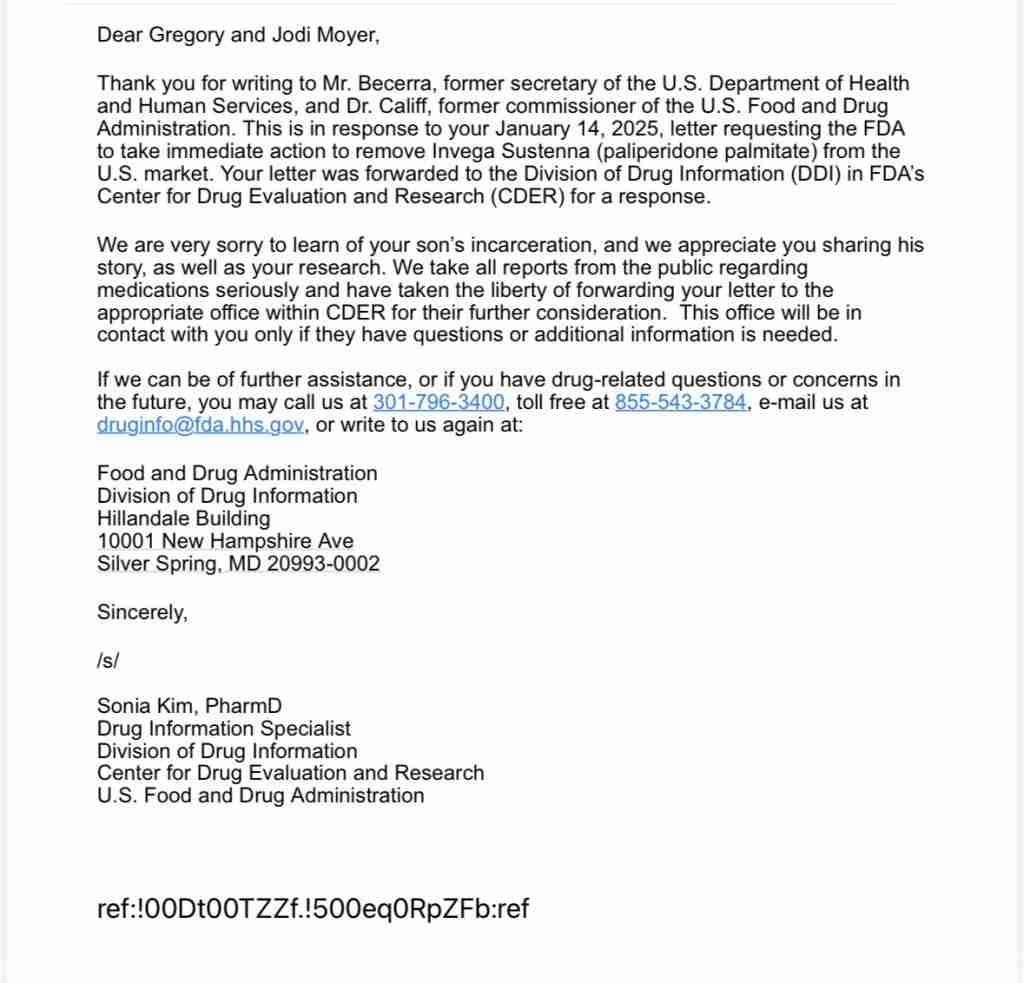
Meanwhile, families like the Moyers faced systemic obstruction and stonewalling at multiple levels of government. Their earnest attempts to report the harmful drug through FDA channels resulted only in circular automated replies from MedWatch, the FDA’s adverse event reporting system. The withholding of critical medical records in Peyton’s criminal trial until the last possible moment potentially breaches constitutional guarantees of due process under the Fifth and Fourteenth Amendments, as the defense was deprived of essential evidence necessary for effective advocacy.
These agencies’ collective failures raise urgent questions about potential violations of federal statutes mandating transparency and accountability, including the Administrative Procedure Act (5 U.S.C. § 551 et seq.), which demands transparency and responsiveness from federal agencies. Moreover, failure to disclose relevant medical and pharmaceutical records to the courts and impacted families might also violate HIPAA Privacy Regulations (45 CFR Part 160 and Subparts A and E of Part 164), specifically regulations requiring accurate, timely, and authorized sharing of medical records to involved parties.
As public agencies and pharmaceutical giants continue to evade responsibility, American families suffer profound and lasting harm. For the Moyers and many others, genuine accountability means a comprehensive investigation by the Department of Justice, potential litigation to hold Johnson & Johnson accountable, and significant regulatory reforms within FDA and HHS to ensure tragedies like Peyton’s never happen again.
Family Court Failures: The Context Behind Peyton’s Early Struggles
While Peyton Moyer was never in foster care, his upbringing was significantly impacted by being trapped in the complexities of the family court system, where he was separated from his father from ages 13 through 18. The troubles started blossoming In 2007, Peyton’s biological father, Gregory, who was employed in risk management and safety for an offshore oil company, sought custody in Waco, Texas, amid growing concerns about Peyton’s welfare. Gregory was even willing to transition to onshore work in his specialized field to provide a stable and safe home environment for Peyton and his siblings. At the time, Peyton’s mother, Ashley, was involved with William Burton “Burt” Schutza, known locally as Burt, who tragically passed away unexpectedly in Waco, Texas, on February 16, 2021. According to Burt’s obituary, he struggled with personal difficulties and instability throughout his life (Lake Shore Funeral Home). Despite these known issues, the family court permitted Ashley to appear telephonically instead of requiring her physical presence, effectively limiting meaningful intervention. Eventually, Ashley began allowing the children to travel and visit their father in California, Texas, Nevada, and other locations—a travel experience they cherished deeply. It wasn’t long after reconnecting in 2021 that Burt killed himself.
Although Ashley later made commendable improvements in her life, Burt’s persistent struggles, including substance-related issues, created ongoing instability that inevitably impacted Peyton’s upbringing. This court failure left Peyton in an environment where substance abuse was normalized, ultimately paving the path toward his later difficulties and illustrating a broader systemic failure to protect vulnerable children adequately.
Moyer consistently worked to guide Peyton onto a healthier, goal-oriented path grounded in faith and stability. Recognizing Peyton’s need for professional counseling and spiritual support, Gregory repeatedly advocated for interventions and mental health assistance. Yet, just as Gregory’s warnings went unheard by the family courts, so too were his urgent calls to crisis hotlines ignored only weeks before the tragic deaths occurred. This repeated neglect underscores a troubling pattern of institutional indifference towards parents—a refusal to acknowledge and act upon clear signs of impending crisis, tragically leaving Peyton without the support and protection he desperately required.
Big Pharma and Government in Lockstep
The Moyers argue that since the Affordable Care Act, HHS has increasingly functioned as a marketing branch for Big Pharma instead of protecting consumers. Vulnerable children in foster care and the juvenile justice system are disproportionately targeted.
According to a Massachusetts DCF study, 20% of foster children are prescribed psychotropic drugs at dosages exceeding FDA guidelines. Other states, like California, require oversight. Federally, however, there are no such requirements.
In recent years, the misuse of psychotropic medications among vulnerable children, particularly those in foster care, has become alarmingly common. According to recent studies, nearly 40% of children in the foster care system are prescribed psychotropic drugs—often in doses exceeding FDA guidelines and without proper oversight (Massachusetts Department of Children and Families Study). While these potent drugs are liberally prescribed to address behavioral or emotional challenges, rarely does the CDC or other public health agencies invest similar resources or emphasis in promoting holistic approaches such as exercise, diet, and mental wellness programs—strategies known to significantly improve mental health in children. This stark disparity highlights a deeply flawed system, prioritizing pharmaceutical interventions over safer, more effective, and less invasive methods of care.
The Overmedication of Youth: A Call for Holistic Approaches
The overprescription of psychotropic medications among foster children is a pressing concern. Studies indicate that youth in foster care are prescribed psychotropic drugs at rates 2.7 to 4.5 times higher than non-foster children covered by Medicaid. This trend underscores the urgent need for alternative interventions.Psychiatry Online
While the Centers for Disease Control and Prevention (CDC) has initiated programs like the State Physical Activity and Nutrition (SPAN) program, funding 17 states over a five-year period to promote physical activity and nutrition, the scale and reach of such initiatives appear limited compared to the widespread reliance on medication. This disparity highlights a systemic issue where quick pharmaceutical solutions are favored over comprehensive, preventive strategies that address the root causes of behavioral and emotional challenges in vulnerable youth.
To truly support the well-being of children in foster care, it is imperative to reevaluate current practices, prioritize holistic approaches, and ensure that medications are prescribed judiciously, with a focus on the child’s best interests.
“Children, inmates and vulnerable persons are not guinea pigs.”
A Call for Action
Loading Viewer…
The Moyers’ Demands Are Simple:
- Immediately ban INVEGA SUSTENNA and its derivatives
- Investigate post-approval violent incidents and mental breakdowns
- Mandate parental involvement in all juvenile mental health drug decisions
- Prosecute Medical Professionals that fail to report crimes against children
- Hold government agencies and pharmaceutical companies accountable for the fallout
In this video, Dr. Josef Witt-Doerring, board-certified psychiatrist and former FDA medical officer, breaks down the essential risks and hidden facts about INVEGA.
This Sunshine Week, while the government touts its commitment to transparency, Peyton Moyer remains in a maximum security prison, a victim of medical experimentation, prosecutorial failure, and institutional neglect.
“We were never consulted. We were never told. Nobody has ever spoken to us about our concerns. Not once.”
As we continue to advocate for Peyton and countless others facing similar struggles, we extend our sincere gratitude toward the current leadership at the U.S. Department of Health and Human Services, and specifically Robert F. Kennedy Jr., for their ongoing efforts to expose and curb the unchecked marketing practices, abuses, and illegalities committed by Big Pharma, NGOs, and related entities. Their fight aligns with our own, highlighting a crucial need for transparency, accountability, and reform in the pharmaceutical industry and government regulatory agencies. We openly acknowledge that navigating these complex legal battles alone is daunting for any family; thus, we are actively seeking a committed and ethical team of attorneys willing to assist in pursuing justice. To DOGE supporters, parents, justice reform advocates, and all who seek accountability in our systems—this fight belongs to you too. We are unequivocally for accountability and justice. But we cannot and must not ignore the reality that vulnerable populations are not guinea pigs, and their lives should never be sacrificed for corporate profit or bureaucratic convenience. If the same prosecutor who lets violent offenders walk free simultaneously ignores the desperate needs of a mentally incompetent teenager, suppresses critical medical records, and obstructs transparency, then clearly something is deeply rotten at the core of our justice system. It’s time we stood together to demand better.
References and Citations:
PMCID Study on Psychotropic Medication
J&J Press Releases
Loading Viewer…
News Media Releases and Marketing
Loading Viewer…
Bad Science
Loading Viewer…
For interviews or to share your story, email editor@theokpost.com or visit www.theokpost.com.
(Writing by DJ Vance; Editing by Robbie Robertson)
By The People’s Popular Paper | Sunshine Week Special Report
2025 -The Oklahoma Post – TheOKPost.com is dedicated to delivering relevant news and information to Oklahomans, sharing their stories, pictures, and experiences. The content on this website includes contributions from various individuals and links to external public and privately owned sources. The views and opinions expressed in user-generated content are solely those of the respective authors and do not necessarily reflect The Oklahoma Post. The Oklahoma Post does not independently verify the accuracy of third-party contributions and rely upon contributors to fact-check their work. By sharing links and allowing open contributions, TheOKPost.com exercises the right to free speech and providing a platform for diverse perspectives.